H5P Community Day Sydney: Learning and Sharing Together
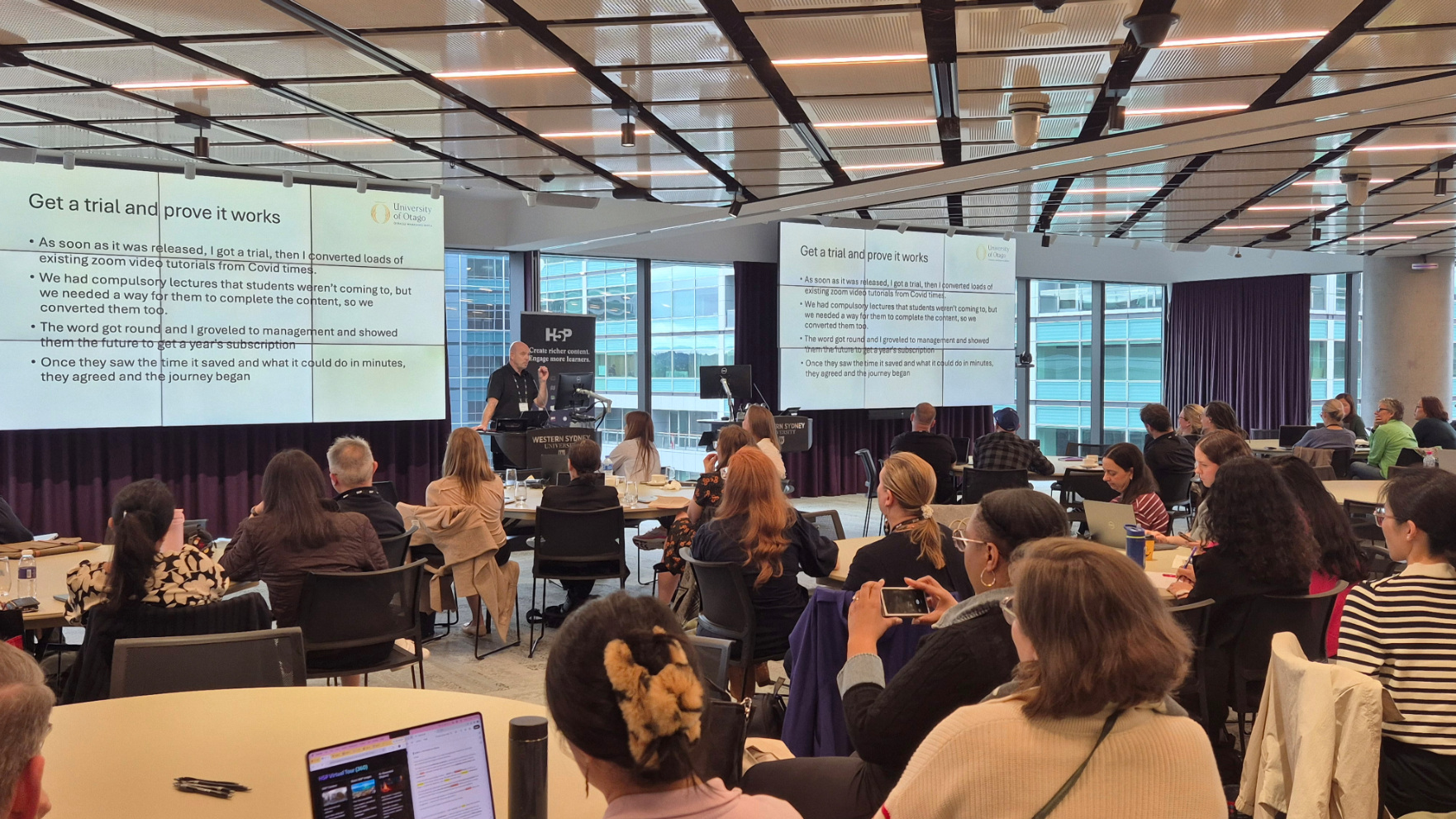
On 26 August 2026, educators, learning designers, developers and H5P users came together at Western Sydney University’s Parramatta City Campus for H5P Community Day Sydney.
It was a day shaped by the community: sharing practical examples, discussing what works (and what doesn’t), exploring new ideas and learning from each other.
Across the sessions, one theme kept coming through. Great digital learning isn’t about adding more technology. It’s about choosing the right tools for the learning experience you want to create.
Looking ahead together
The day began with H5P Senior Director of Sales Nils Viken and Community Manager Kelly Choi sharing some of what’s happening across H5P and the wider community.
They covered developments including the OER Hub, improvements to the learner experience, interactive video, accessibility, hotspots, open-source workflows and AI-assisted content creation.
There was also a look at what’s ahead, including better AI-assisted authoring, improved data and reporting, broader LMS and LTI support, and continued work on reliability, accessibility and plugin stability.
Just as importantly, the session highlighted the role the community continues to play in shaping H5P. Community maintainers, open-source contributions and monthly webinars are creating more ways for people to contribute, share feedback and help one another.
Designing learning with purpose
Dr Kashmira Dave from the University of New England explored how H5P can support adaptive learning pathways.
Instead of treating interactive activities as individual additions to a course, Kashmira showed how videos, quizzes, reflective prompts and branching scenarios can work together to create structured learning experiences.
The discussion brought things back to an important principle: pedagogy comes first. Interactivity is most useful when it has a clear purpose within the learning journey.
Using AI to transform existing learning content
Scott Hallman from Otago Medical School Christchurch shared his team’s three-year journey transforming recorded lectures into interactive learning modules with H5P.
The team has been experimenting with AI-assisted authoring to turn existing material into tutorials containing videos, transcripts, summaries and questions.
In one example, 35 lectures were converted in a single day. Another project reduced course development to around three or four weeks, while a case-based learning initiative achieved 90% pre-task completion in its first year.
Scott also shared an important reminder: AI-generated content is a starting point, not the finished product. Subject matter experts remain essential for reviewing, refining and approving what is created.
Exploring immersive learning
Zoe Zhang from Victoria University took us into a different kind of learning environment, demonstrating how H5P Virtual Tour and AI-generated imagery can be used to create immersive 360-degree experiences.
Learners could explore virtual spaces, move between rooms, watch videos, answer questions and reflect on what they were learning.
One interesting takeaway was that a virtual environment doesn’t always need to recreate a real place perfectly. Instead, it can provide the context and atmosphere needed to support the learning experience.
Bringing strategy to life through gamification
Benedict Ciantar from RMIT University shared the “Strategy Sprint”, a branching scenario created for a business strategy course.
Students worked together in teams, took on executive roles and responded to challenges based on Australian retailer Myer. They had to discuss each problem, make decisions and explain their reasoning.
The project also provided a useful lesson in keeping things simple. An early version became difficult to manage, so the team rebuilt the activity around a clearer branching structure.
The result was a collaborative and practical activity that helped connect theoretical concepts with workplace decision-making.
Accessibility, quality and sustainability
Victor Renolds and Tonmoy Bhattacharya from La Trobe University showcased their award-winning Mass Casualty Incident branching scenario.
The paramedic simulation puts students into an emergency involving a chlorine gas leak, with branching decisions, mini-games, feedback and inclusive character design.
The team shared five principles behind their work:
- Accessibility
- Quality
- Usability
- Scalability
- Sustainability
They also spoke openly about their experience using generative AI. Different tools worked better for different tasks, and experimentation sometimes took more time rather than less.
It was a useful reminder that while the technology will keep changing, good learning and design principles remain important.
Combining H5P with other learning tools
Dolores Turro from Western Sydney University The College demonstrated how H5P activities were embedded within Articulate Rise modules for a nursing subject.
Interactive videos, branching scenarios, sorting activities, image sliders and quizzes were used to support a flipped learning approach, helping students explore important concepts before attending class.
The project was also a great example of collaboration between learning experience designers, online learning environment designers and subject matter experts.
Rather than starting from scratch each time, the team was able to reuse and adapt existing H5P content, with feedback from students and teachers helping to guide further improvements.
How much interactivity is enough?
Elizabeth Georgiades from Torrens University Australia finished with a question worth thinking about: does adding more interactive content always create better learning?
Her session explored the “cost of interactivity” and encouraged learning designers to consider whether the time and effort involved in creating an activity are appropriate for what learners need to achieve.
Sometimes a simple image hotspot might be enough. In other situations, a more involved branching scenario could be exactly what’s needed.
The important question isn’t how many interactions we can add. It’s what those interactions are helping learners to do.
Thank you to our Sydney community
H5P Community Day Sydney showcased just some of the ways people are using H5P across higher education, from medical education and paramedic simulations to business strategy, nursing, academic development and AI literacy.
But what made the day special was the opportunity to bring people together.
The conversations between sessions, practical demonstrations, questions, shared challenges and willingness to talk openly about both successes and lessons learned are what community events are all about.
A huge thank you to everyone who presented, attended, asked questions and shared their experiences and to Western Sydney University for bringing us together.
We’re looking forward to continuing the conversation.
If you’d like to connect with other H5P users, ask questions, share what you’re working on or get involved, join the H5P community on Matrix.